
Phillips County Arrest Records
An arrest record is the law-enforcement side of the event. It may show who was arrested, when booking occurred, what charge labels were entered at intake, bond status, and whether the person is still in local custody. In Phillips County, current custody is handled through the Sheriff's Office and jail roster. Formal court charges are a different step. The Phillips County Attorney prosecutes misdemeanor and felony criminal cases and decides how charges are filed in District Court.
That distinction matters because a jail roster charge may be an arrest or booking allegation, while a court charge is the filed allegation in the criminal case. The District Court record is where arraignment, plea, motions, disposition, sentencing, and later post-conviction events are tracked. For the full court file, use Phillips County criminal court records. For current custody details and roster fields, use the inmate records page.
The sheriff roster inspected for Phillips County showed charge text stored behind a "View" link, with Kansas statute-style citations and descriptions in tooltip text. That is useful for current custody review, but it is still a jail record. A filed court charge should be confirmed through the district court case record because the prosecutor may file fewer, more, or different counts than the booking entry first showed.
The official traffic diversion application page is one of the County Attorney channels tied to charge resolution.
Diversion links show that not every filed charge moves straight to conviction or trial.
Court Charges After Arrest
The charge path usually starts with arrest and booking, then prosecutor review. The prosecutor may file the same allegation listed at booking, file a different charge, reduce it, add counts, decline prosecution, or offer diversion when a case qualifies. Once filed, the charge belongs to the court record and is searched through Kansas district court channels.
- Check current custody through the sheriff roster if the person may still be in jail.
- Search Kansas CaseSearch for the District Court case by defendant name or case number.
- Read each count separately, since one arrest can produce several court charges.
- Look for amended, dismissed, diverted, or convicted language before treating a charge as final.
- Call the Clerk of the District Court for public copies or certified copies not available online.
The criminal diversion page is an official source for the existence of a local criminal diversion application channel, although the research did not capture field-level form detail.
When a diversion path applies, the public record may not read the same way as a conviction record.
For copy requests, use the custodian that holds the record. Sheriff booking records route to the Sheriff's Office. Filed criminal charges and court dispositions route to the Clerk of the District Court. Prosecutor diversion questions route to the County Attorney. Municipal ticket and warrant questions route to Phillipsburg Municipal Court when the issue is a city case.
Charging Document Table
Phillips County research identifies complaints, informations, and indictments as the charging document types to explain for court charge records. The exact document in a case depends on the offense, prosecutor action, and court process. Search results may summarize charge data, while copies from the clerk may be needed to read the filed document.
| Document | Who Uses It | What It Does |
|---|---|---|
| Complaint | Law enforcement or prosecutor path | States alleged facts and offense counts used to start or support a criminal case. |
| Information | Prosecutor | Lists formal charges filed by the prosecutor in District Court. |
| Indictment | Grand jury process | Charges returned through a grand jury process when used. |
The county sheriff staff listing gives the local sheriff contact channel for arrest-side questions.
That office can answer custody and law-enforcement contact questions, while filed charges belong with the court and prosecutor path.
Charge Status in Phillips County
A charge can change. The filed count may be pending after arraignment, amended during negotiations, dismissed by order, reduced under a plea, or resolved through diversion. The docket must be read with dates because an older charge entry may no longer reflect the active count or final outcome.
Use the newest docket event and the count-level disposition together. One case can have several charges with different outcomes.
When names are common, the case number, filing date, and court county help keep one Phillips County defendant from being confused with another Kansas case.
| Status | What It Means |
|---|---|
| Pending | The charge is filed and not yet finally resolved. |
| Amended | The prosecutor or court record changed the original count or language. |
| Reduced | The charge was changed to a lesser offense, often as part of case resolution. |
| Dismissed | The count was ended without conviction on that count. |
| Diversion | The case follows an agreement that may avoid conviction if conditions are met. |
| Convicted | A plea or verdict resulted in guilt on that count. |
The Phillips County sheriff and courthouse FAQ is another local routing source for questions that cross between court and sheriff offices.
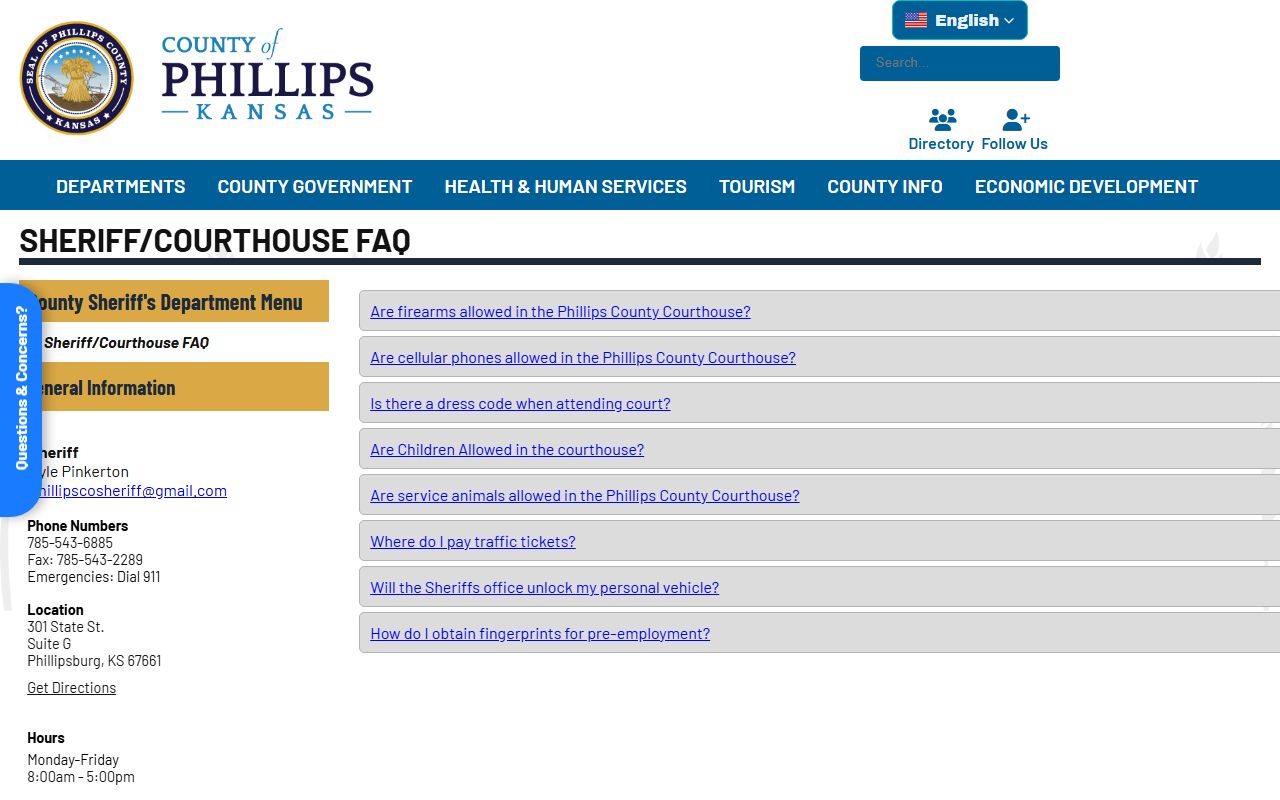
Routing matters because arrest records, charges, warrants, and case outcomes can sit with different custodians.
Charge vs Conviction
A charge is not proof of guilt. Phillips County court charges after arrest should be checked against the disposition field, sentencing entries, dismissal orders, and diversion outcome. A charge may stay visible as a historical docket entry even when the final case result is different.
| Point | Charge | Conviction |
|---|---|---|
| Core Meaning | Allegation filed in court. | Guilty result by plea or verdict. |
| Timing | Appears near the start of the case. | Appears after final adjudication or plea acceptance. |
| Record Reading | Must be checked for amendments and dismissal. | Must be checked for sentence, probation, fines, and later relief. |
For statewide history, use the KBI registered offender registry only for registry status, not general charge search.
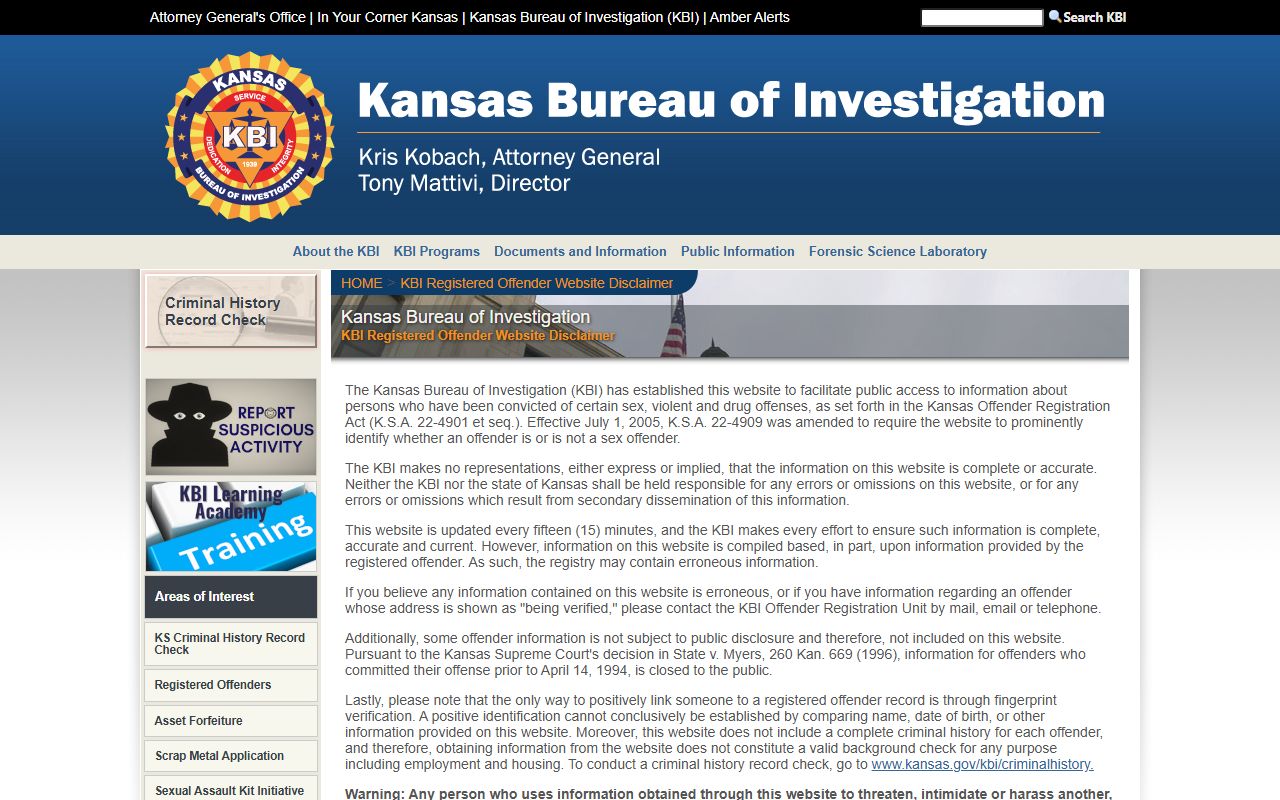
Registry records have their own legal basis and should not be treated as a substitute for the filed charge record.
Restricted Arrest and Charge Records
Kansas public access is shaped by the Kansas Open Records Act, court access rules, and case-specific limits. Adult criminal charge records are often public, but juvenile offender records, child-in-need-of-care files, sealed cases, expunged records, mental-health material, and protected personal identifiers are not ordinary public material. The County Attorney handles juvenile offender and child-in-need-of-care matters, but public access is narrower than adult criminal cases.
Expungement under Kansas law can limit public access to qualifying arrest records, convictions, and diversion records. It does not mean every agency and statutory use disappears in every context. If a Phillips County arrest or charge record has been sealed or expunged, the public search path may show nothing, or it may show a restricted result. The court order and Kansas law control the effect.
Kansas court-record request research also matters for charge records. The Judicial Branch says court-record requests are acted on by the end of the third business day after receipt unless more time is needed. Published court copy fees include ordinary page copies, certified documents, mailing, faxing, and staff time when preparation is required. That process is for court records, not a promise that restricted arrest or investigation records will be released.
Phillips County also has separate state-level tools that should not be merged into one arrest-record search. KBI criminal history is a fee-based Kansas criminal-history record check, while the KBI registered offender registry is for people required to register under Kansas law. KDOC KASPER is for state corrections or supervision status. None of those replaces the sheriff roster for current local custody, and none replaces the District Court case file for formal charges, pleas, disposition, and sentencing.
For a practical Phillips County arrest records search, start with the record type needed. Current custody goes to the sheriff roster or Sheriff's Office. Filed charges go to Kansas CaseSearch or the Clerk of the District Court. Diversion questions go to the County Attorney. Municipal tickets and municipal warrants go to Phillipsburg Municipal Court when the issue is a city case. Using the right custodian reduces false matches and keeps booking allegations separate from court-filed charges.
The research also supports a clear timing rule. An arrest record may exist before the prosecutor has filed a charge, and a filed charge may later be amended, reduced, dismissed, diverted, or resolved by plea or trial. Treat the newest District Court docket entry and count-level disposition as more reliable for court outcome than the first booking label.
An official Sedgwick County release documented the June 27, 2025 Phillipsburg law-enforcement investigation involving the death of Phillips County Deputy Brandon Gaede and suspect Kolton Griffith.
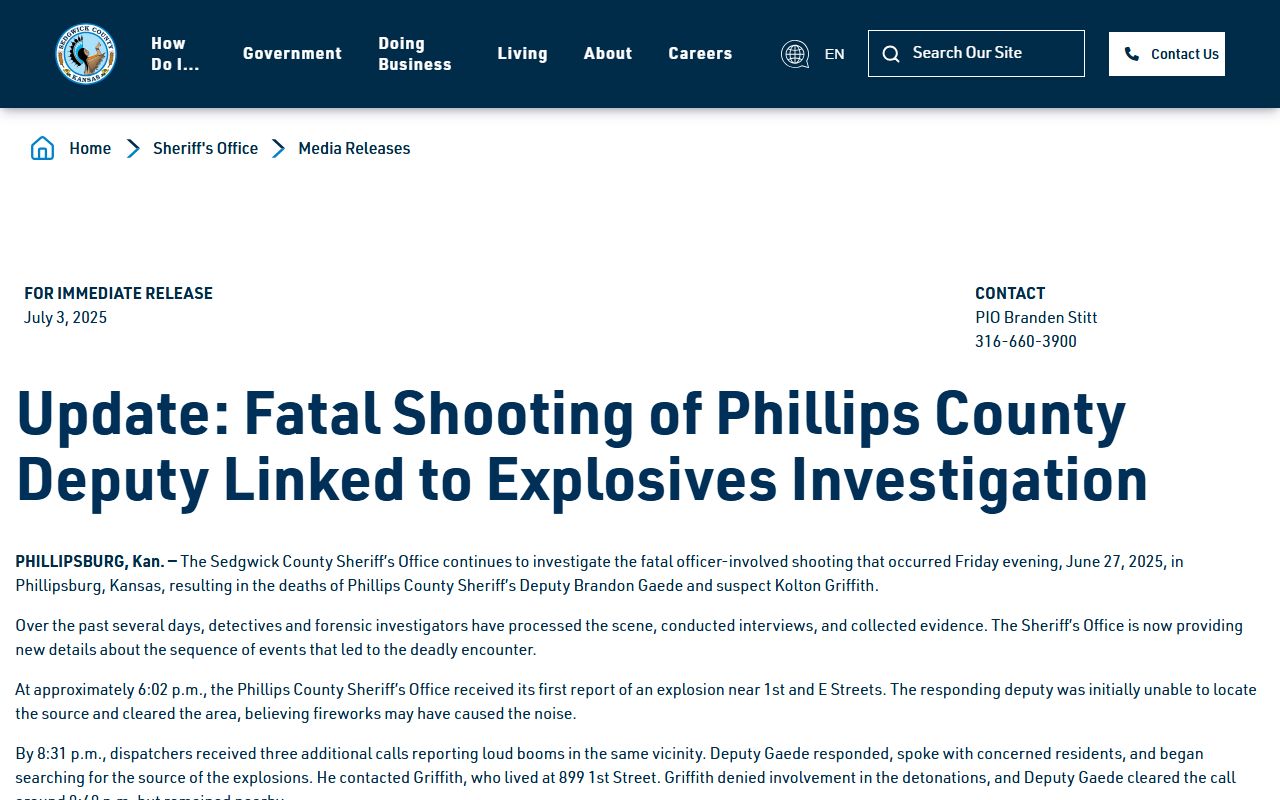
That dated release is a reminder that active investigations may involve records outside ordinary court-charge access.