
Phillips County Probate Records
Probate in Phillips County is handled by the District Court. The Phillips County District Court page states that Kansas district courts have jurisdiction over probate and administration of estates, guardianships, conservatorships, care of the mentally ill, juvenile matters, civil cases, criminal cases, domestic cases, small claims, and traffic or fish-and-game matters. No separate Phillips County probate court page or separate probate judge page was found in the official research.
That structure affects where a request goes. Estate petitions, wills, letters, inventories, creditor notices, accountings, guardianship orders, and conservatorship filings belong with the District Court file. If a probate case causes a deed, affidavit, death certificate related to real estate, easement, or title-transfer document to be recorded, the land-record document may also appear with the Register of Deeds. The court file and the recorded land document are different records.
The Kansas Probate Code is the successful source image assigned to this Phillips County probate records page. Chapter 59 covers estate administration, inventories, demands, management and sale of assets, accountings, distribution, guardianship, conservatorship, summary proceedings, small personal property transfer affidavits, and probate appeals.
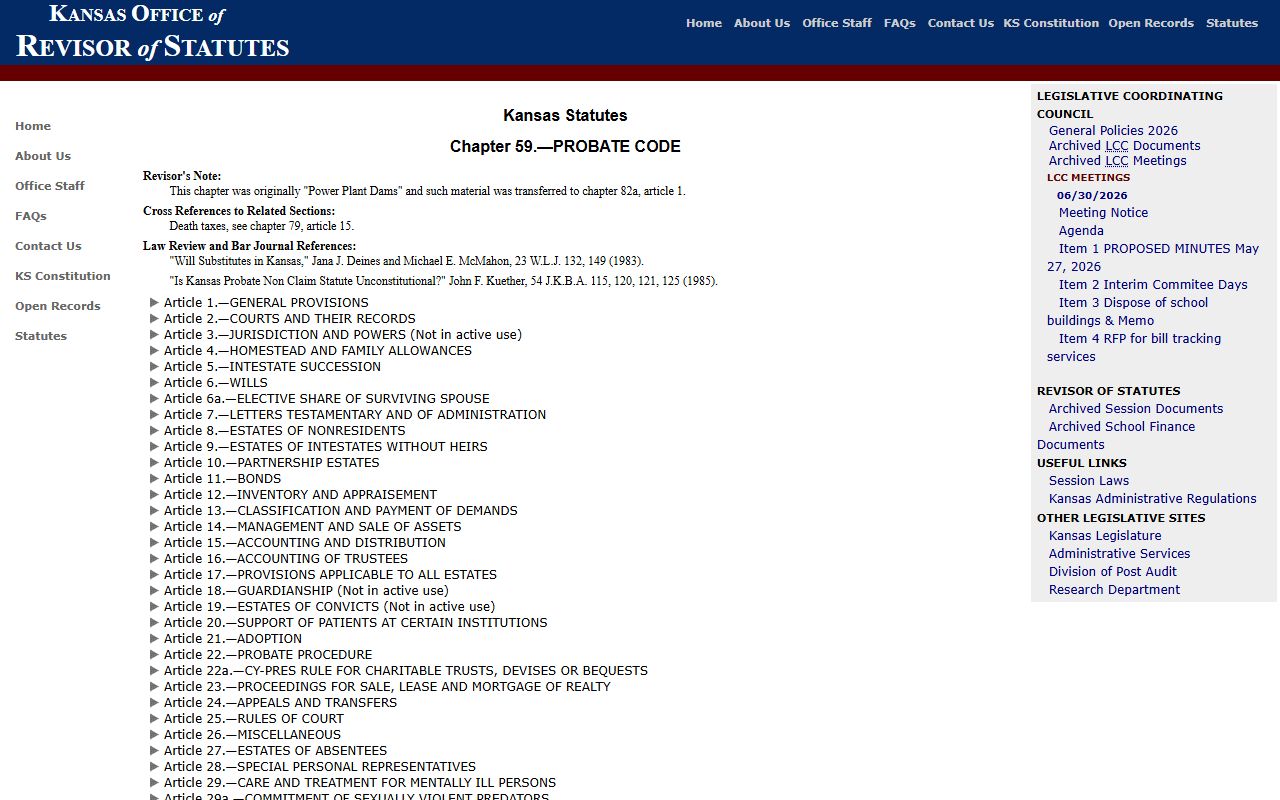
The statute source supports the subject matter, while the local filing and copy request still runs through the Phillips County District Court clerk.
Phillips County Probate Court Contact
Because probate is a division of the District Court in Phillips County, the relevant contact is the Clerk of the District Court. Use this office for filing questions, public case-copy requests, certified probate copies, and older estate-file access. The clerk can process filings and records requests, but cannot choose forms, draft pleadings, explain strategy, or decide whether a summary proceeding is available.
Phillips County District Court
Clerk of District Court: Lauren Schmidt
301 State Street, Suite E
Phillipsburg, KS 67661
785-543-6830
Fax: 785-543-6832
Email: pldc@kscourts.gov
Monday-Friday 8:00 AM-5:00 PM, closed legal holidays
Phillips County Probate Terms
Probate files use terms that can be plain once they are separated by role. A person searching Phillips County probate records may see one term on the case caption, another on a court order, and another in a later accounting or real-estate transfer. These definitions are for reading the record, not for choosing a legal filing.
- Testator
- A person who made a will.
- Executor
- A person named to carry out the will after court authority is granted.
- Intestate
- Dying without a will, which means Kansas law controls who may inherit.
- Letters testamentary
- Court authority showing a fiduciary may act for an estate.
- Guardianship
- A court arrangement for personal-care decisions for another person.
- Conservatorship
- A court arrangement for managing another person's property or finances.
Phillips County Probate Workflow
The probate path depends on the type of case. A decedent's estate may need a will admitted, letters issued, creditor demands handled, property sold, or a final settlement approved. A guardianship or conservatorship may need a petition, hearing notice, appointment order, inventory, annual accounting, and later review. The Kansas Judicial Council publishes probate and guardianship forms, but its probate publication is aimed at probate attorneys and does not replace case-specific advice.
- Decide whether the matter is a formal estate, summary proceeding, affidavit transfer, guardianship, or conservatorship.
- Review official Kansas Judicial Council forms or consult counsel. The court clerk cannot give legal advice.
- File in Phillips County District Court if Phillips County is the proper venue.
- Provide required notice or hearing notice under Kansas Probate Code and court orders.
- Obtain letters or orders if the court appoints a fiduciary.
- Handle inventory, creditor claims, taxes, property transfers, accountings, and reports as required.
- Record estate-related deeds or affidavits with the Register of Deeds when real estate transfer documents are required.
- Close the estate or protective matter through final settlement, distribution, discharge, or later court order.
Search Phillips County Probate Records
Start with Kansas CaseSearch when the probate matter is a public district court case and enough detail is known to search by party, case number, business name, citation, or other criteria available to the user. For probate, names may include the estate, decedent, petitioner, fiduciary, guardian, conservator, ward, protected person, or interested party. If the case is sealed, restricted, too old for online access, or missing from the public portal, use courthouse terminal access or contact the district court clerk.
Documents that may appear in a probate case include wills, petitions, notices, orders admitting a will, letters testamentary, letters of administration, inventories, appraisements, creditor demands, orders for sale, accountings, reports, final settlement documents, and decrees of distribution. Guardianship and conservatorship files can include personal, medical, and financial material, so public access may be narrower than for a routine estate file.
Note: Sealed probate records, confidential medical details, and restricted guardianship material are not ordinary public search results.
Phillips County Probate Fees
The research did not locate a Phillips-specific probate docket-fee schedule. It did confirm Kansas district court fee sources and Kansas Judicial Branch copy-fee rules. For that reason, probate filing fees should be confirmed with the Clerk of the District Court before filing. Copy fees and certified-copy fees are supported by the court-record request research and can guide records requests.
| Probate Item | Supported Fee or Action |
|---|---|
| New probate estate filing | Confirm current filing fee with the Clerk of the District Court |
| Guardianship or conservatorship filing | Confirm current filing fee with the Clerk of the District Court |
| Plain public court-record copy | 25 cents per page under Kansas Judicial Branch court-copy fee research |
| Certified probate document | $10 per certified document |
| Mailing first five pages | 50 cents, then 25 cents for each additional five pages |
| Clerical document preparation | $20 per hour, charged in quarter-hour increments when applicable |
When probate also requires land records, the Register of Deeds has its own fees. Those fees are for recorded deeds, UCC filings, reports, or copies, not for the district court probate case.
Restricted Phillips County Probate Records
Kansas public access rules and KORA do not make every probate detail public. A simple estate docket may be public, but medical, minor, mental-health, care and treatment, protected-person, or financial identifier information may be restricted or redacted. K.S.A. 45-221 identifies categories agencies are not required to disclose, and Kansas court access rules also protect confidential electronic district court case records.
For copies, identify the case and document as clearly as possible. Ask for public copies if a general records search is enough. Ask for certified copies when the document must be used for banking, title transfer, court filing, or an out-of-county proceeding. If access is denied or limited, the clerk may be applying a statute, court rule, redaction requirement, or court order.
Phillips County probate records can also connect to non-court records. When an estate transfers real estate, the District Court probate file may show the order or fiduciary authority, while the Register of Deeds records the deed, affidavit, death-certificate-related real estate document, easement, or other land instrument. A complete estate search may require both offices, especially when the question is who now holds title to land.
The Register of Deeds research also notes two access limits that matter near probate work: Kansas Real Estate Sales Validation Questionnaires and military discharges are closed by state statute. Those records are not ordinary probate court records, but they may appear in the same family or property-history research. The probate page should therefore avoid promising a single all-record search for estate, land, and military-discharge material.
For certified probate copies, use the Clerk of the District Court. For recorded land copies, use the Register of Deeds. For legal forms, use Kansas Judicial Council resources, while remembering that the Judicial Council probate publication is intended for attorneys and does not replace legal advice. The clerk can process filings and copies, but cannot decide which probate procedure fits a particular estate.
Probate timing also varies by the type of case. A simple demand, notice, or small-transfer issue will not look like a supervised estate with inventories, creditor claims, accountings, and final settlement. Guardianship and conservatorship files can remain active for years, so the docket should be checked for current orders before relying on an older entry.